Importance of Data Security and Cybersecurity
Data security and cybersecurity are often used interchangeably, both aimed at protecting information and technology assets. Data security focuses on safeguarding information directly, while cybersecurity secures technology to protect that information. Both fields uphold the confidentiality, integrity, and availability of data-the CIA triad. Confidentiality restricts access, integrity ensures data accuracy, and availability guarantees reliable access. A security incident compromises the CIA, a data breach involves unauthorized disclosure, and a cyberattack is an unauthorized attempt to compromise assets. Security threats to information and technology are diverse and continually evolving.
Public and private organizations are increasingly accumulating vast amounts of information as individuals create and share data. Both groups rely more on information and technology for goods and services, often entrusting their data to others. Digital technology adoption is rising globally. In developing countries, households with a home computer grew from 15.6% in 2005 to 36.1% in 2019. Mobile phone subscriptions tripled worldwide and quadrupled in low- and middle-income nations from 2005 to 2020. Additionally, registered mobile money accounts reached 1.21 billion in 2020, growing by 12.7%-double the expected rate.
Developing countries face growing cybersecurity challenges as they become more reliant on digital technologies. Financial services in African nations have experienced various security breaches, including phishing attacks and system outages. In 2016, Africa reported 24 million malware incidents, with Ghana's financial sector alone facing 400,000 such incidents. Critical infrastructure, like electricity grids, is also vulnerable to cyberattacks, as seen in Ukraine and South Africa. These threats highlight the need for improved cybersecurity measures in developing economies.
Global direct losses from cybercrime nearly doubled to $945 billion in 2020, with cybersecurity spending reaching $145 billion, totaling 1.3% of global GDP. Africa alone lost $3.5 billion to cybercrime in 2017. These figures exclude indirect and systemic costs, which could triple the total impact to around $4 trillion, or 4% of global GDP. Developing countries are particularly vulnerable, as evidenced by major incidents like the $81 million Bangladesh Bank heist in 2016 and similar cases in other emerging economies.
Threats and Motives
In 2020, financial motives drove 70% of security incidents, with organized crime responsible for 80% of data breaches. However, other motivations exist:
1. Hacktivists: Driven by political, social, or religious ideologies (e.g., 2011 MasterCard attack over WikiLeaks)
2. Personal motives: Vanity, revenge, or outrage
3. State-sponsored actors: Pursuing geopolitical or military goals through cyber espionage, election interference, or sabotage
This diversity of motivations highlights the complex landscape of cybersecurity threats beyond purely financial objectives.
Cybercriminals use both technical exploits and social engineering to breach systems. Technical methods involve exploiting vulnerabilities, as seen in the 2017 Equifax breach affecting 147 million consumers. Social engineering, used in 92% of 2020 data breaches, often involves phishing tactics where attackers pose as trusted entities. This combination of technical and human-focused approaches allows cybercriminals to bypass security measures and access sensitive data or systems.
Cybercriminals employ diverse attack methods. Distributed Denial of Service (DDoS) attacks hijack third-party computers as "zombies" or "bots" to flood target systems, causing slowdowns or crashes. These often have non-financial motives. Malware, another common tactic, is used to extract information, withdraw funds, or demand ransoms. It was Europe's top cybersecurity threat from 2019 to 2020. Both methods are prevalent, with malware featuring in most 2020 data breaches and DDoS involved in nearly 60% of all security incidents.
Countermeasures to strengthen cybersecurity
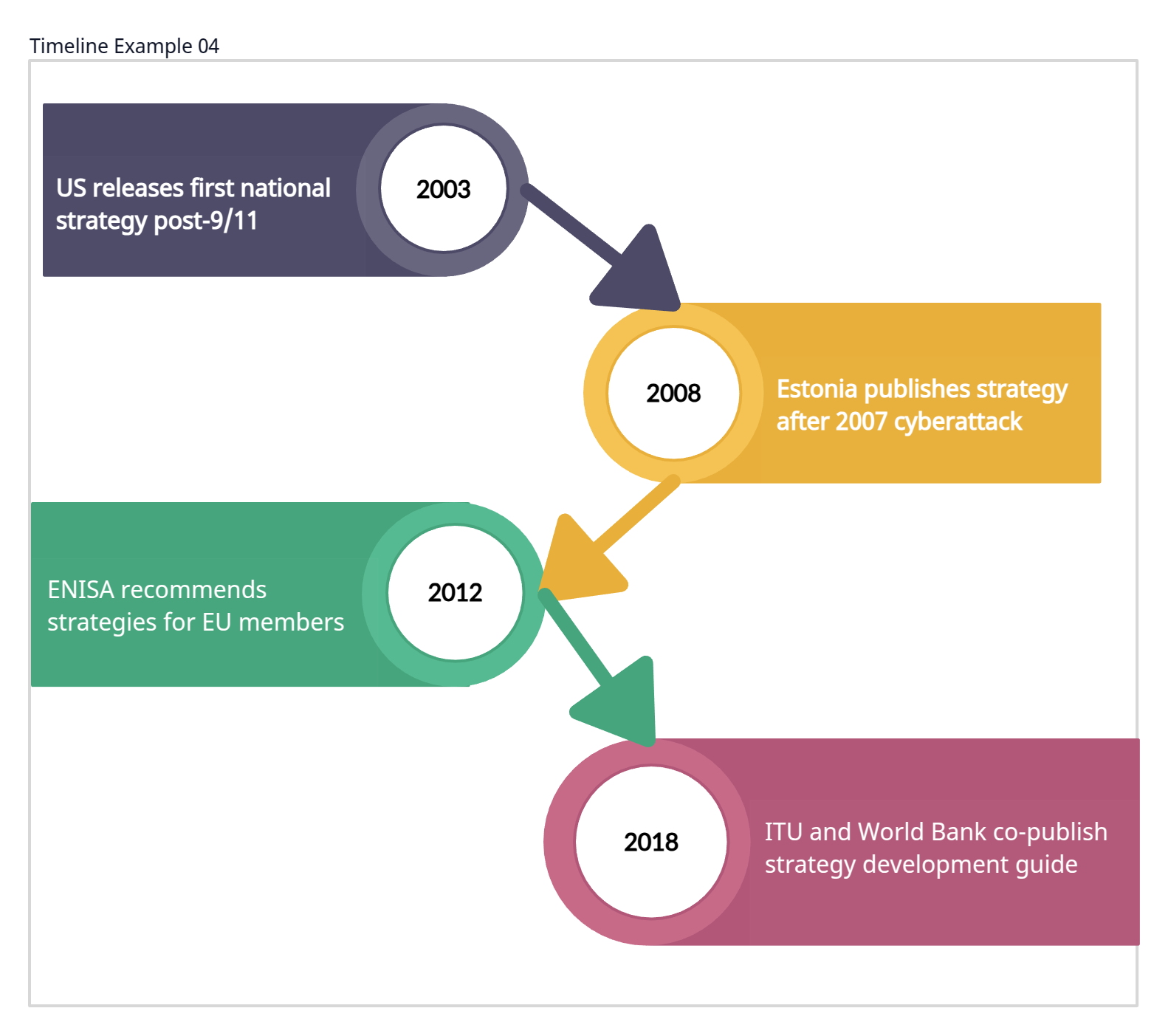
Global cybersecurity enhancement requires international cooperation due to the digital ecosystem's borderless nature. The UN World Summit on the Information Society (2003 and 2005) initiated efforts to increase Internet access in developing countries, foster a global cybersecurity culture, and boost international cooperation. The International Telecommunication Union leads WSIS cybersecurity actions, providing support to developing countries. The UN Office of Counter-Terrorism also runs a cybersecurity program. These efforts highlight the need for coordinated action among various stakeholders to address complex cybersecurity challenges. Figure 3 shows the different national cybersecurity strategies over the years.
Figure 3: Key Developments in Adopted National Cybersecurity Strategies
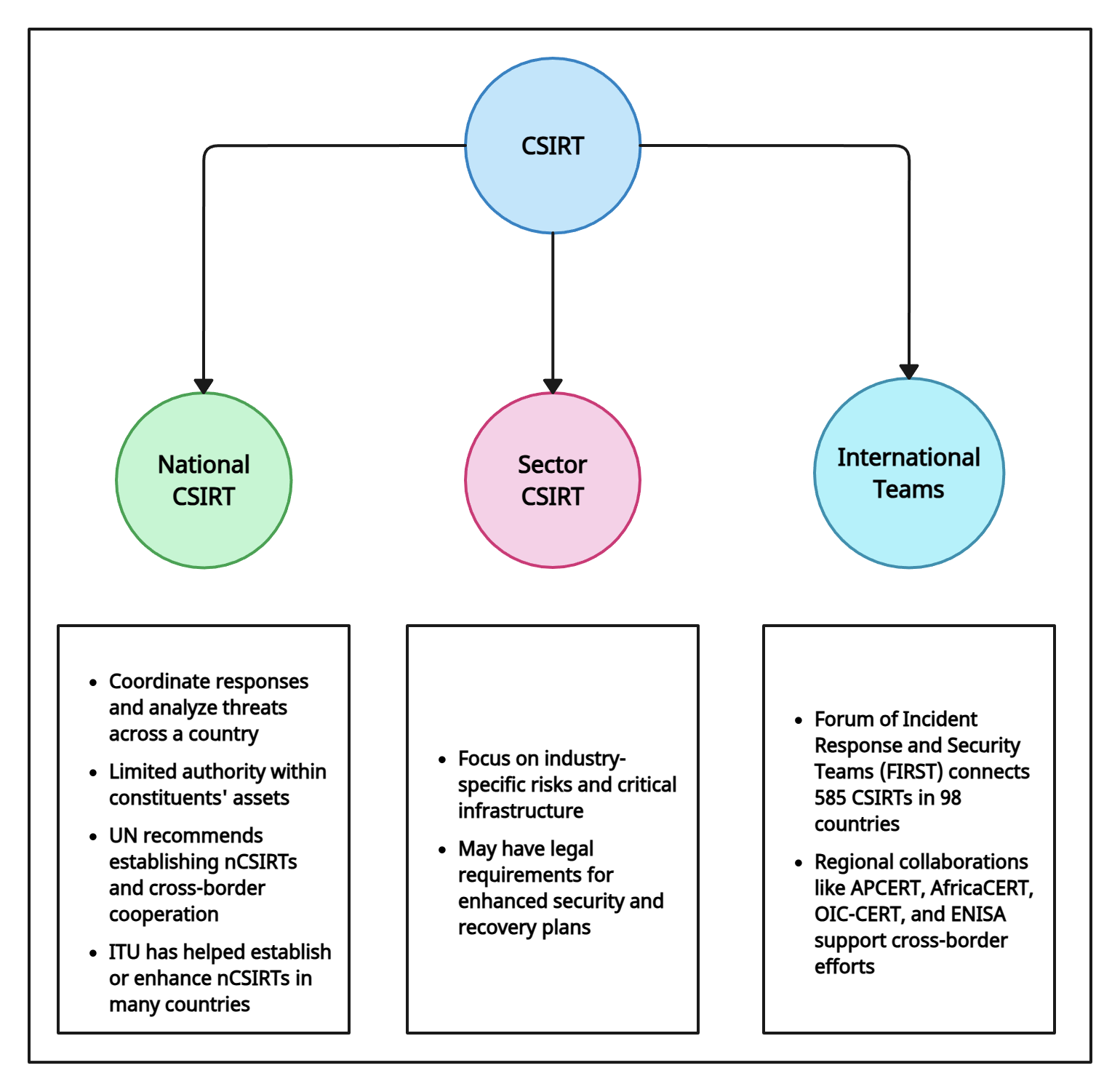
Many governments have adopted national cybersecurity strategies to enhance security and resilience of infrastructure and services. These top-down plans establish national objectives, priorities, and timelines. Currently, at least 114 countries worldwide have adopted or are developing national cybersecurity strategies, spanning all major regions. This approach has gained significant traction globally as a response to growing cyber threats. Figure 4 shows the Computer Security Incident Response Teams (CSIRT) created at national, sector and international levels.
Figure 4: Computer Security Incident Response Teams (CSIRT) at different levels
Many nations have established dedicated cybersecurity agencies to lead policy development, coordinate implementation across sectors, and serve as official contact for cybersecurity incidents. World Bank data reveals the prevalence of these agencies varies by income level: 86% of high-income countries, 65% of upper-middle-income countries, 66% of lower-middle-income countries, and 24% of low-income countries have such agencies. This trend underscores the growing prioritization of cybersecurity governance, particularly in more economically developed nations.
Conclusion
In the rapidly evolving landscape of the digital economy, cybersecurity has become a critical concern for global enterprises, governments, and individuals alike. The borderless nature of digital threats necessitates a coordinated, multi-faceted approach to protection and response. As cyber threats continue to grow in sophistication and scale, the global community has responded with increasingly robust strategies and structures. From national cybersecurity agencies and strategies to international cooperation through CSIRTs, the world is mobilizing to meet this challenge.
However, the disparity in cybersecurity readiness between high-income and low-income countries highlights the need for continued global collaboration and resource sharing. Ultimately, protecting the digital economy requires ongoing vigilance, adaptation, and cooperation across borders and sectors. As technology advances, so too must our cybersecurity measures, ensuring a safer digital future for enterprises and individuals worldwide.
References
1. Ditkowsky, A. (2022a, July 29). The role of cybersecurity and data security in the digital economy - UNCDF Policy Accelerator. UNCDF Policy Accelerator.
2.
www.ETCIO.com. (2021, March 18). Cybersecurity in the borderless digital enterprise. Brand Connect Initiative.