In the digital era, businesses leverage technologies like big data and AI for competitive advantage. These tools enhance data processing and decision-making capabilities, crucial for predicting trends, optimizing operations, and understanding customers. Predictive analytics, real-time processing, and NLP improve planning, inventory management, and customer insights. However, implementing AI in traditional businesses faces challenges:
1. Integration with legacy systems
2. Ethical concerns (algorithmic bias, data privacy)
3. Employee resistance due to automation fears
Despite these obstacles, AI's potential remains significant. Future advancements in quantum computing and autonomous systems promise further operational improvements.

Strategies for Leveraging Big Data and AI in Decision-Making

Predictive analytics, key to modern business intelligence, uses historical data to forecast trends. Retailers, for example, predict sales by analyzing past data and economic indicators. It improves forecasting accuracy by 30%, boosting efficiency. Machine learning optimizes inventory by analyzing buying patterns. Figures show predictive analytics' impact when used with big data.
Real-time data processing revolutionizes finance, logistics, and retail, enabling quick, informed decisions. In finance, it speeds up transactions by 20% and aids high-frequency trading. In logistics, AI-driven processing optimizes routes, cutting delivery times by 15% and reducing costs. Real-time inventory tracking prevents stock issues. This technology is vital in competitive markets, allowing rapid responses to operational problems, market changes, and demand fluctuations. It boosts responsiveness, efficiency, and profitability, giving businesses a competitive advantage in fast-paced environments.
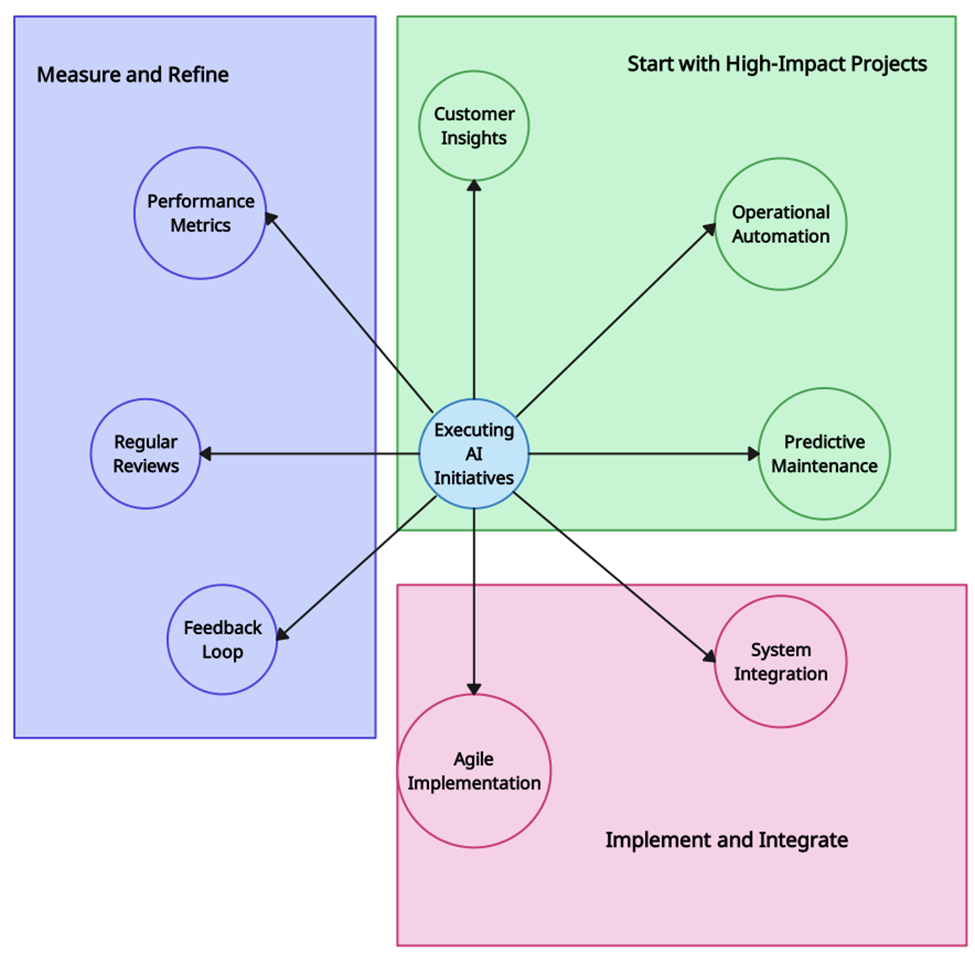
Natural Language Processing (NLP) revolutionizes business data analysis, processing unstructured information from various digital channels in real-time. It extracts insights on customer sentiments and preferences, improving decision-making. An e-commerce company using NLP reduced negative delivery reviews by 20% by identifying and addressing recurring issues. Service industries report 25% higher customer retention with NLP-powered sentiment analysis. NLP helps track online discussions, refine products, and improve customer service. It converts unstructured data into actionable insights, enhancing business processes. As NLP advances, its use will grow, helping companies better understand customer needs and build long-term loyalty and profitability. Figure 1 shows the execution of AI initiatives.
Figure 1: Executing AI initiatives

Challenges in Implementing Big Data and AI Solutions

Big data and AI adoption raises significant data security and privacy concerns. AI analytics increase data breach risks, particularly for sensitive information. Recent AI-related breaches in healthcare resulted in large fines. GDPR and CCPA regulations necessitate stronger data protection. Companies must prioritize encryption and secure storage to avoid legal issues and retain consumer trust. Most consumers would stop using services of companies they don't trust with their data.
Unbiased AI decision-making is a key ethical challenge. AI models often show bias, particularly in hiring, leading to issues like a tech company's discontinued recruitment tool that favored males. To address this, AI models require diverse training data and clear accountability, with human oversight in critical sectors. 'Explainable AI' (XAI) is emerging as a solution, offering transparency in AI decision processes for fairer outcomes.
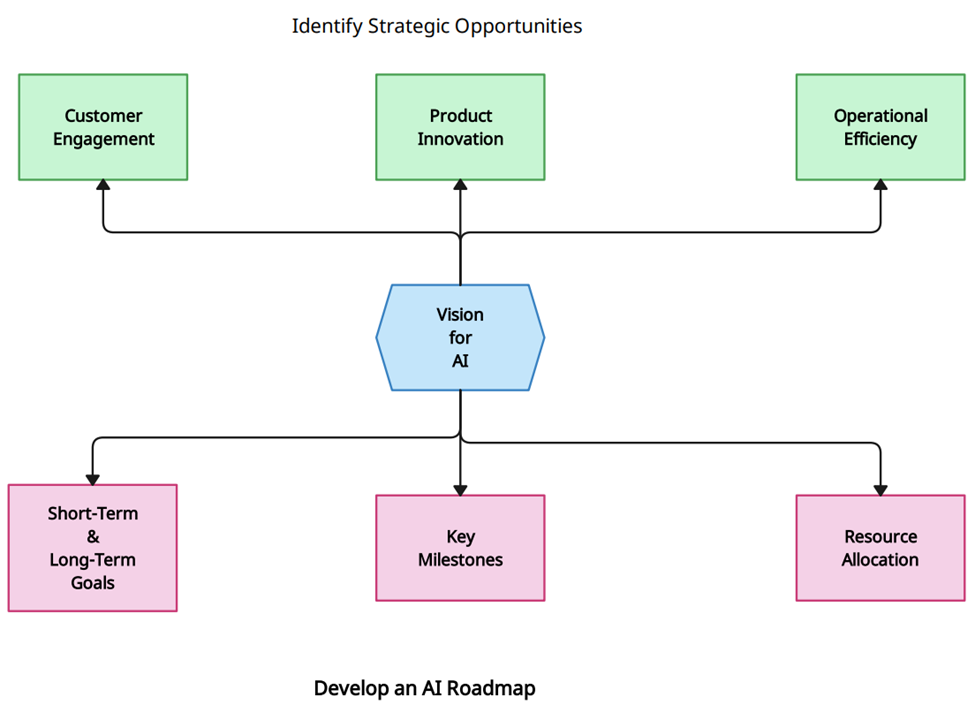
Integrating AI and big data into businesses is complex and costly, particularly when aligning with legacy systems in industries like manufacturing and transportation. Employee resistance due to job displacement fears is a major challenge. Companies should offer training that presents AI as a tool to enhance, not replace, human work. Effective integration is best achieved through a gradual, function-specific approach before company-wide implementation. Figure 2 shows the vision for AI.
Figure 2: Vision for AI

Future Directions for Big Data and AI in Business Decision-Makings

NLP transforms business by converting unstructured data (70-90% of company data) into insights. It automatically processes and interprets data from various sources in real-time, extracting patterns, sentiments, and actionable feedback. A major e-commerce company used NLP to analyze customer reviews and comments, identifying delivery issues promptly. This real-time analysis led to quick operational changes, reducing negative reviews by 20% within months. NLP's ability to efficiently process vast amounts of previously unmanageable data is revolutionizing customer experience-focused industries, enabling timely issue resolution and improved customer satisfaction.
Autonomous AI systems are growing in logistics and manufacturing, with AI expected to make over half of business decisions by mid-2020s. These systems optimize supply chains, cut costs, and improve deliveries. However, this trend challenges industries needing human judgment, creating a duality: AI handles routine tasks independently, while critical decisions require human oversight. For example, AI-managed financial portfolios need human alignment with business strategy and risk tolerance.
AI-driven hyper-personalization is emerging as a crucial customer engagement strategy. It offers customized experiences, improving satisfaction, loyalty, and conversion rates. A streaming service successfully used this for content recommendations, boosting retention. However, hyper-personalization needs large databases and complex algorithms, raising data management and privacy concerns.

Conclusion

Harnessing AI for competitive advantage requires a multifaceted approach that combines strategic foresight, solid groundwork, effective implementation, and ongoing expansion. Business leaders must develop a comprehensive strategy that aligns AI initiatives with overall business objectives. The process begins with identifying strategic opportunities where AI can create significant value. This involves a thorough analysis of the business landscape, customer needs, and internal processes to pinpoint areas where AI can drive innovation, efficiency, or new revenue streams. Building the right foundation is crucial. This includes investing in robust data infrastructure, adopting cloud technologies, and ensuring data quality and accessibility. Equally important is cultivating AI talent, either through hiring, upskilling existing staff, or partnering with external experts. Effective execution is the next critical step. This involves implementing high-impact AI projects that deliver tangible results. These projects should be carefully selected based on their potential to address key business challenges or capitalize on emerging opportunities. It's essential to start with pilot projects that can demonstrate quick wins and build momentum for larger initiatives.
Scaling AI across the organization is an ongoing process. As initial projects prove successful, businesses should look to expand AI applications to other areas, continuously refining and optimizing their AI strategies. This scaling process often requires significant organizational change, including redesigning workflows, redefining roles, and fostering a data-driven culture. Throughout this journey, fostering a culture of innovation is paramount. This involves encouraging experimentation, embracing failure as a learning opportunity, and promoting cross-functional collaboration. Leaders should create an environment where employees are empowered to explore AI's potential and contribute ideas for its application. By adopting this comprehensive approach - combining strategic vision, solid foundations, effective execution, and continuous scaling - business leaders can fully leverage AI's transformative power. This not only drives substantial value creation but also positions the organization to stay ahead in an increasingly competitive and AI-driven market landscape. The ability to adapt and evolve with AI technologies will be a key differentiator for businesses in the coming years, making this strategic approach to AI adoption crucial for long-term success.

References

1. Catanzariti, A. (2024, August 26). Leveraging AI for competitive advantage: Strategies for business leaders. https://www.LinkedIn.com/pulse/leveraging-ai-competitive-advantage-strategies-angel-catanzariti-txfkf/
2. Tang, N. (2024). Leveraging big data and AI for enhanced business decision-making: Strategies, challenges, and future directions. Journal of Applied Economics and Policy Studies, 11(1), 25–29. https://doi.org/10.54254/2977-5701/11/2024098

Author

Shahab Anbarjafari
Senior Director, AI Engineering