Challenges in Software Development
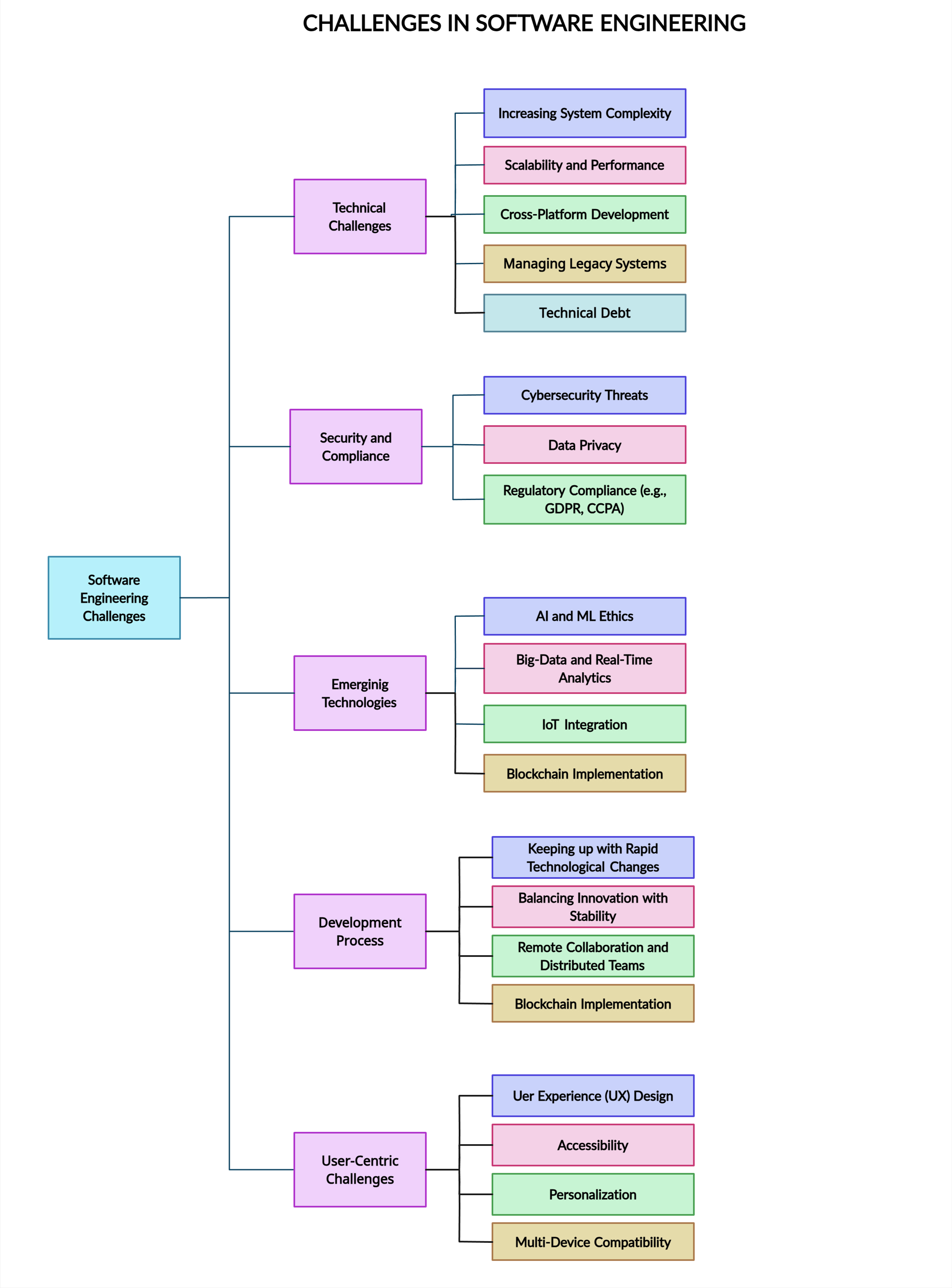
Despite these significant advancements, the software engineering field continues to face several challenges. Figure 2 shows the different challenges in software development process.
Increasing Complexity of Systems: Modern applications often integrate multiple technologies, frameworks, and third-party services, making it difficult for developers to maintain a comprehensive understanding of the entire system.
Security Concerns: Software engineers must constantly stay updated on the latest security threats and implement robust security measures throughout the development lifecycle.
Scalability and Performance: Engineers must design systems that can handle increased loads, optimize database queries, and implement caching strategies to maintain responsiveness under varying conditions.
Technical Debt: The pressure to deliver features quickly often leads to accumulating technical debt. Managing and reducing technical debt requires a delicate balance between delivering new features and refactoring existing code.
Keeping Up with Rapid Technological Changes: Software engineers must continuously learn and adapt to stay relevant, which can be overwhelming and time-consuming.
Cross-platform Development: Engineers must consider different screen sizes, input methods, and platform-specific features while maintaining a consistent user experience.
Data Privacy and Compliance: Engineers must ensure that applications handle user data in compliance with these regulations, implementing features like data encryption, user consent mechanisms, and the right to be forgotten.
Managing Legacy Systems: Integrating legacy systems with modern technologies, or gradually replacing them without disrupting business operations, presents significant technical and logistical challenges.
Figure 2: Different Challenges in Software Development
Ethical Considerations in AI and Machine Learning: Engineers face new ethical challenges including addressing bias in AI algorithms, ensuring transparency in decision-making processes, and considering the societal impacts of AI-driven systems.
Remote Collaboration and Distributed Teams: Ensuring effective coordination, maintaining team cohesion, and managing productivity in distributed environments require new tools and practices.
User Experience (UX) Design: Software engineers must work closely with UX designers to implement complex functionality while maintaining simplicity and ease of use.
Testing in Complex Environments: Engineers face challenges in testing microservices architectures, IoT systems, and AI-driven applications, requiring new testing strategies and tools.
Balancing Innovation with Stability: Engineers must find ways to introduce new technologies and features without compromising the stability of existing systems.
Sustainability and Green Computing: Software engineers are increasingly challenged to develop energy-efficient applications and consider the environmental impact of their software systems, particularly in data-intensive applications.
Handling Big Data and Real-time Analytics: Engineers must design systems capable of handling large volumes of data and providing real-time insights, often requiring specialized knowledge in big data technologies and analytics.
Addressing these challenges requires a combination of technical skills, continuous learning, adaptability, and a holistic understanding of both business needs and technological possibilities. As the field of software engineering continues to evolve, tackling these challenges will be crucial in developing robust, efficient, and innovative software solutions.