Transforming Healthcare with AI, Telemedicine, and Data-Driven Insights

Like all other niches around us, the healthcare landscape too is going through a profound transformation, mostly driven by rapid advancements in technology, especially artificial intelligence (AI).
AI have revolutionized the field of healthcare by leveraging vast datasets of medical records, imaging, and patient histories to provide more accurate and timely diagnoses. Telemedicine, on the other hand, serves as a crucial link between patients in remote areas and specialized healthcare providers, offering essential consultations, follow-up care, and chronic disease management (Pervez et al, 2025). I have witnessed the increasing integration of artificial intelligence (AI), telemedicine, and data-driven care into our daily practice. And in 2025, it is finally time to acknowledge that innovations are not just trends; they represent the future of healthcare and are definitely here to stay. Getting on top of these advancements and learning to work with them can help us enhance patient outcomes, improve basic and advanced healthcare accessibility, and fundamentally upgrade how we deliver care.

AI: Driving Efficiency, Precision and Accessibility in Healthcare

AI is no longer something that's coming; it is here and is a present-day reality in healthcare today. Whether you look at diagnostic tools that can identify diseases much earlier than traditional methods, right down to the completely personalized multi-factor treatment plans that use complex algorithms, healthcare is now far more intelligent, thanks to AI. Even when it comes to AI-assisted surgeries, data references that these could shorten hospital stays by over 20% and lead to potential savings of $40 billion annually (Dialog Health, n.d.).
The integration of AI with telemedicine allows for real-time decision support, enhancing clinical outcomes by offering data-driven insights during virtual consultations. And this global healthcare transformation is truly driven by the rapid advancement and integration of artificial intelligence (AI), telemedicine, and data-driven care. These technologies, operating not in isolation but in synergy. And they hold the potential to revolutionize patient outcomes, enhance healthcare accessibility, and optimize resource allocation. This article enables to have an insight into the integrated impact of these transformative forces on the future of healthcare delivery, while analysing their combined capabilities to redefine diagnostics, therapeutic interventions, and patient-provider interactions.
However, challenges persist, such as ensuring equal access to these technologies, addressing digital literacy gaps, and managing the ethical implications of AI-driven decisions. While these technologies offer immense promise, a detailed and critical examination of the ethical considerations and implementation challenges is required, especially challenges related to algorithmic bias, data privacy, and regulatory frameworks, to ensure equitable and responsible deployment. Despite these obstacles, the combination of AI and telemedicine shows great promise in reducing healthcare disparities and improving the quality of care in rural settings. This potential for advancement underscores the importance of continued research and investment in these technologies to ensure that all patients have access to the best possible care (Pervez et al, 2025). This article aims to offer a comprehensive overview of the synergistic potential of AI, telemedicine, and data-driven care, while acknowledging the complexities inherent in their widespread adoption.

Evolution of AI in Healthcare

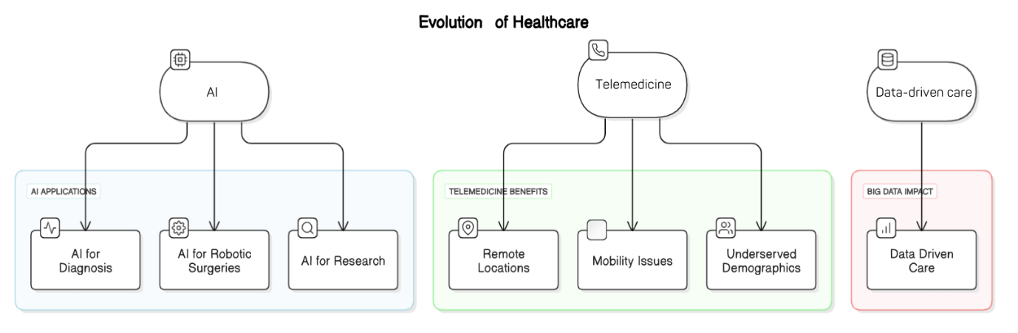
The healthcare landscape is currently grappling with a confluence of challenges that necessitate innovative solutions. The escalating costs of healthcare delivery, coupled with an aging global population, strain existing healthcare systems and exacerbate access disparities. To address these pressing issues, the healthcare industry is increasingly turning to technological advancements. Artificial intelligence (AI), telemedicine, and data-driven care have emerged as transformative forces with the potential to revolutionize healthcare delivery today.
Figure 1: Evolution of Healthcare

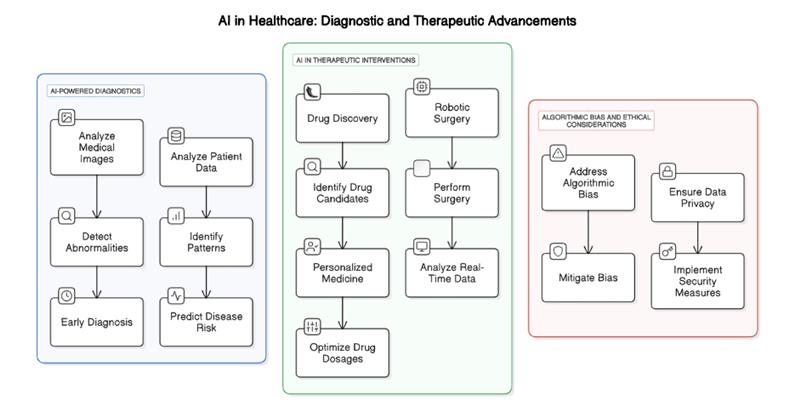
Artificial Intelligence in Healthcare: Diagnostic and Therapeutic Advancements

Artificial intelligence (AI) is poised to revolutionize healthcare across various domains, from diagnosis and treatment to drug discovery and patient care. Following throws light in a more detailed manner.
AI-Powered Diagnostics:
AI algorithms are demonstrating remarkable capabilities in analysing medical images, surpassing human accuracy in certain instances. In radiology for example, AI excels at detecting subtle abnormalities in X-rays, CT scans, and MRIs much earlier than humans can, aiding in the early diagnosis of conditions like cancer and cardiovascular diseases. Similarly, in pathology, AI algorithms can analyse microscopic images of tissue samples, assisting pathologists in identifying cancerous cells and predicting disease progression. Beyond image analysis, AI algorithms are currently being developed to analyse vast amounts of patient data at scale, including electronic health records, genetic information, and even wearable device data. This can help identify subtle patterns and risk factors, facilitating early disease detection and personalized diagnostic approaches. For example, AI algorithms can now predict the risk of developing certain diseases based on an individual's lifestyle, genetic predisposition, and environmental factors.
AI in Therapeutic Interventions:
AI is transforming therapeutic interventions by accelerating new drug discovery and enabling personalized medicine. AI algorithms can analyse massive datasets of chemical compounds and biological interactions to identify potential drug candidates, significantly reducing the time and cost associated with traditional drug development. Furthermore, AI-powered platforms can analyse individual patient data to predict responses to treatment and even optimize drug dosages, enabling personalized treatment plans that maximize efficacy and minimize side effects. AI-driven robotic surgery is another area of significant advancement. Robotic systems equipped with AI algorithms can perform complex surgical procedures with increased precision and reduced invasiveness. AI algorithms can also analyse real-time data during surgery, such as image data and patient vitals, to guide surgical decisions and optimize surgical outcomes.
Algorithmic Bias and Ethical Considerations:
While AI offers immense potential, it is crucial to address the ethical considerations and potential pitfalls, namely:
  • * Algorithmic bias, where AI systems reflect and amplify existing biases in the data they are trained on, can lead to discriminatory outcomes in healthcare. For example, AI algorithms trained on biased datasets may misdiagnose or misclassify patients based on race, gender, or socioeconomic status. Mitigating algorithmic bias requires careful data curation, rigorous testing, and ongoing and continuous monitoring of AI systems.
  • * Data privacy and security concerns stemming from the collection and analysis of sensitive patient data, raising concerns about data breaches and unauthorized access. Robust data security measures, including encryption, access controls, and adherence to data privacy regulations, are essential to protect patient information and maintain trust.
Figure 2: AI in Healthcare: Diagnostic and Therapeutic Advancements

Advancements in Telemedicine: Expanding Access and Redefining Patient-Provider Interactions

Evolution of Telemedicine:
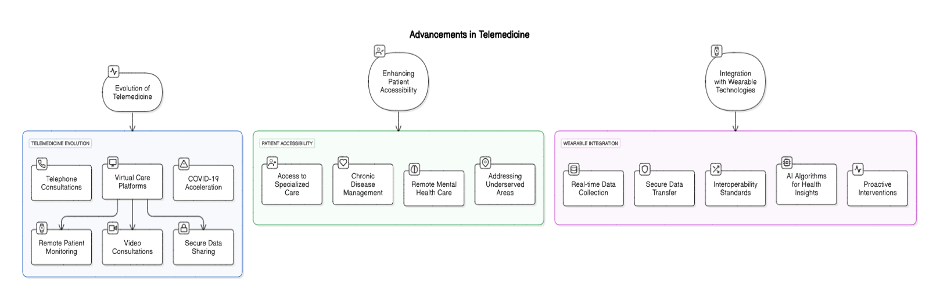
Telemedicine has evolved from simple telephone consultations to sophisticated virtual care platforms that enable remote patient monitoring, video consultations, and secure data sharing. The COVID-19 pandemic accelerated the adoption of telemedicine, highlighting its potential to enhance access to care and reduce healthcare costs. Remote patient monitoring utilizing wearable devices and IoMT (internet of Medical Things) sensors enables continuous tracking of vital signs and health parameters, facilitating proactive interventions and chronic disease management. Virtual consultations provide convenient access to healthcare services, particularly for patients in remote areas or have mobility issues.
Telemedicine thus brings with it several key benefits, namely:
  • * Improved access and the opportunity to serve the under-served or the immobile.
  • * Significant cost savings that would otherwise be spent on transport, from physical facilities, and other logistics.
  • * Improved convenience with regards to anywhere, anytime healthcare access.
  • * Better care for chronic conditions that require regular and periodic consultations.
  • * Remote supervision on critical conditions through the use of wearables that provide real-time data on vital signs, activity levels, and sleep pattern.
  • * Accessible, convenient and private medical health services where there is associated stigma, such as mental health.
  • * Improved patient engagement and keeping up with follow-up appointments due to sheer convenience and affordability.
  • * Personalized health insights and proactive interventions for patients, through the integration of wearable data with AI algorithms.
Figure 3: Advancements in Telemedicine

The Era of Data-Driven Care: Personalization and Predictive Analytics

Data-driven care represents a paradigm shift in healthcare delivery, leveraging the vast repositories of patient data to personalize treatments, predict health outcomes, and optimize resource allocation.
Leveraging Big Data and Electronic Health Records (EHRs):
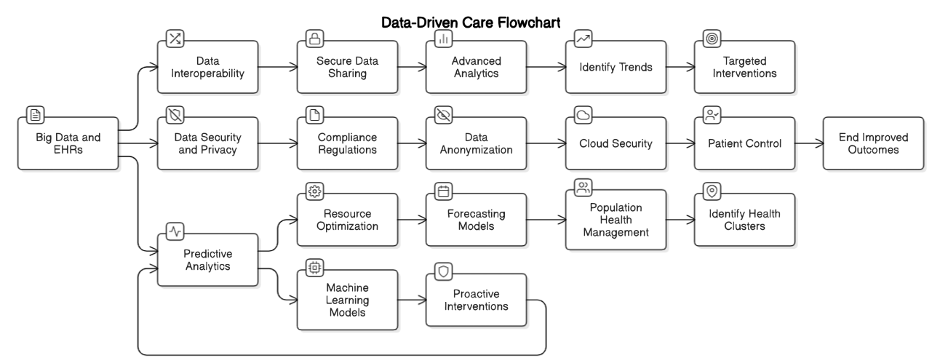
The foundation of data-driven care rests on the effective utilization of big data and Electronic Health Records (EHRs). Data interoperability, the ability of different systems to exchange and utilize information, is paramount. Seamless data sharing among healthcare providers, laboratories, and pharmacies ensures a comprehensive view of the patient's medical history. Secure data sharing protocols, including robust encryption and access controls, are essential to protect patient privacy and maintain data integrity.
EHRs, when coupled with advanced big data analytics, provide invaluable insights into patient health and disease patterns. By analysing large datasets, researchers can identify trends, risk factors, and treatment effectiveness, leading to improved patient outcomes and early diagnosis. For example, big data analytics can identify patient cohorts at high risk for specific complications, enabling targeted interventions and preventive measures. Furthermore, it allows for the analysis of drug effectiveness across diverse patient populations, leading to more personalized and effective medication regimens.
Predictive Analytics and Population Health Management:
Predictive analytics, powered by machine learning algorithms, plays a crucial role in identifying at-risk populations and optimizing healthcare resource allocation. These models analyse patient data, including demographics, medical history, and lifestyle factors, to predict the likelihood of developing specific diseases or experiencing adverse events. This allows for proactive interventions, such as targeted screening programs and personalized prevention strategies.
Data analytics also enables healthcare organizations to optimize resource allocation by identifying areas of high demand and predicting future needs. For example, predictive models can forecast hospital bed occupancy, emergency department visits, and the spread of infectious diseases, allowing for timely resource adjustments and improved operational efficiency. Population health management benefits greatly from the ability to identify clusters of people with specific health risks, and target those areas with specific interventions.
Challenges in Data Security and Privacy:
The increasing reliance on data-driven care raises significant concerns regarding data security and patient privacy. Compliance with regulations such as HIPAA (Health Insurance Portability and Accountability Act) in the United States, GDPR (General Data Protection Regulation) in Europe, and similar legislation worldwide is crucial to protect sensitive patient information. These regulations mandate stringent data security measures, including encryption, access controls, and regular security audits.
Maintaining patient privacy in a data-driven environment presents unique challenges. The collection, storage, and analysis of vast amounts of patient data create opportunities for data breaches and unauthorized access. Balancing the need for data sharing with the caveat of protecting patient privacy requires careful consideration of data anonymization techniques, data governance policies, and patient consent mechanisms. Moreover, the increasing use of cloud-based data storage and analysis platforms necessitates robust security measures to safeguard data against cyber threats too. The need for transparency and patient control over their data is also a growing concern.
Figure 4: Data-Driven Care Flowchart

Synergistic Future and Implementation Challenges

It is beyond doubt that the convergence of artificial intelligence (AI), telemedicine, and data-driven care heralds a transformative era in healthcare, offering the potential to create a more efficient, personalized, and accessible system. These technologies, when synergistically integrated, can revolutionize diagnostics, therapeutics, and patient management, leading to improved outcomes and enhanced quality of life. However, realizing this potential requires navigating significant implementation challenges such as:
  • * Finding ways to tackle algorithmic bias
  • * Bringing in stricter laws and compliance regulations related to data and privacy
  • * Ensuing strict enforcement and regulatory compliance for all parties involved
Regulatory hurdles, including the need for updated frameworks that accommodate rapid technological advancements, and ethical concerns, such as algorithmic bias and data privacy, demand careful consideration and proactive solutions. Overcoming these challenges necessitates interdisciplinary collaboration among clinicians, engineers, policymakers, and ethicists.
This means, continuous innovation, coupled with rigorous evaluation and validation, is essential to ensure the safe and effective deployment of these technologies. Ultimately, the future of healthcare lies in the responsible and equitable integration of these transformative tools, fostering a patient-centric ecosystem that leverages the power of technology to improve global health and well-being. This future is not merely a possibility, but an imperative, demanding a proactive and collaborative approach to harness the synergistic potential of AI, telemedicine, and data-driven care for the betterment of humanity.

Conclusion

I truly believe that the integration of AI, telemedicine, and data-driven care will offer unprecedented opportunities to improve patient outcomes, enhance accessibility, and optimize care delivery worldwide. After all, the global market for AI in healthcare is projected to reach $188 billion by 2030 (Dialog health, n.d.). It is reported that, 86% of tech vendors, healthcare providers, and life science companies are already using AI (Binariks, n.d.).
In recent times, it is critical to band together and embrace these advancements in healthcare and work collaboratively to navigate this digital frontier responsibly. By staying informed, adapting to change, and prioritizing patient-centred care, we can harness the power of technology to create a healthier future for all.
That said though, having witnessed the evolution of healthcare over the past two decades, I believe that the future lies in a balanced approach. While technology offers tremendous potential, it is essential to remember that human connection remains at the heart of patient care. My hope for the near future is that we can leverage technology to enhance, not replace, the doctor-patient relationship.

Reference

Bhandari, M., Zeffiro, T., & Reddiboina, M. (2020). Artificial intelligence and robotic surgery: current perspective and future directions. Current opinion in urology, 30(1), 48-54. https://doi.org/10.1097/MOU.0000000000000692
Binariks. (n.d.). Artificial Intelligence in Healthcare: Market Size, Growth, and Trends. https://binariks.com/blog/artificial-intelligence-ai-healthcare-market/
Buolamwini, J., & Gebru, T. (2018). Gender shades: Intersectional accuracy disparities in commercial gender classification. In Conference on fairness, accountability and transparency (pp. 77-91). https://proceedings.mlr.press/v81/buolamwini18a.html
Coudray, N., Ocampo, P. S., Sakellaropoulos, T., Narula, N., Snuderl, M., Fenyö, D., & Tsirigos, A. (2018). Classification and mutation prediction from lung adenocarcinoma histopathology using deep learning. Nature medicine, 24(10), 1559-1567. https://doi.org/10.1038/s41591-018-0177-5
Dialog Health. (n.d.).AI in Healthcare Statistics: Comprehensive List for 2025. https://www.dialoghealth.com/post/ai-healthcare-statistics
Dwork, C., Hardt, M., Pitassi, T., Reingold, O., & Zemel, R. (2012). Fairness through awareness. In Proceedings of the 3rd innovations in theoretical computer science conference (pp. 214-226) https://dl.acm.org/doi/10.1145/2090236.2090255
Johnson, A. E., Pollard, L., Shen, L., Lehman, L. W., Feng, M., Ghassemi, M., Moody, G., Wu, A. H., & Mark, R. G. (2016). MIMIC-III, a freely accessible critical care database. Scientific data, 3, 160035. https://doi.org/10.1038/sdata.2016.35
Litjens, G., Kooi, T., Bejnordi, B. E., Setio, A. A. A., Ciompi, F., Ghafoorian, M., & Sánchez, C. I. (2017). A survey on deep learning in medical image analysis.Medical image analysis,42, 60-88. https://www.sciencedirect.com/science/article/abs/pii/S1361841517301135?via%3Dihub
McKinney, S. M., Sieniek, M., Godbole, S., Godwin, J., Antropova, N., Ashrafian, H., ... & Etemadi, M. (2020). International evaluation of an AI system for breast cancer screening. Nature, 577(7791), 670-673. https://doi.org/10.1038/s41586-019-1799-6
Obermeyer, Z., Powers, B., Vogeli, C., & Mullainathan, S. (2019). Dissecting racial bias in an algorithm used to manage the health of populations. Science, 366(6464), 447-453. https://doi.org/10.1126/science.aax2342
Perez, K.; Wisniewski, D.; Ari, A.; Lee, K.; Lieneck, C.; Ramamonjiarivelo, Z (2025). Investigation into Application of AI and Telemedicine in Rural Communities: A Systematic Literature Review. Healthcare 13,324. https://doi.org/10.3390/healthcare13030324
Radixweb. (n.d.). The Impact of AI in Healthcare: A Statistical Analysis. https://radixweb.com/blog/ai-in-healthcare-statistics
Rajkomar, A., Dean, J., & Kohane, I. (2019). Machine learning in medicine. New England Journal of Medicine, 380(14), 1347-1358. https://doi.org/10.1056/nejmra1814259
Schneider, P., Walters, M. A., Plowright, A. T., Sieroka, N., Listgarten, J., Goodnow, R. A., & Hopkins, A. L. (2020). Rethinking drug discovery in the artificial intelligence era. Nature Reviews Drug Discovery, 19(6), 353-364. https://doi.org/10.1038/s41573-019-0050-3
Topol, E. (2019). Deep medicine: How artificial intelligence can make healthcare human again. Basic Books. ISBN: 9781541644632. https://psnet.ahrq.gov/issue/deep-medicine-how-artificial-intelligence-can-make-healthcare-human-again

Author

Vijetha Ibbandhi
Manager - Product Strategies